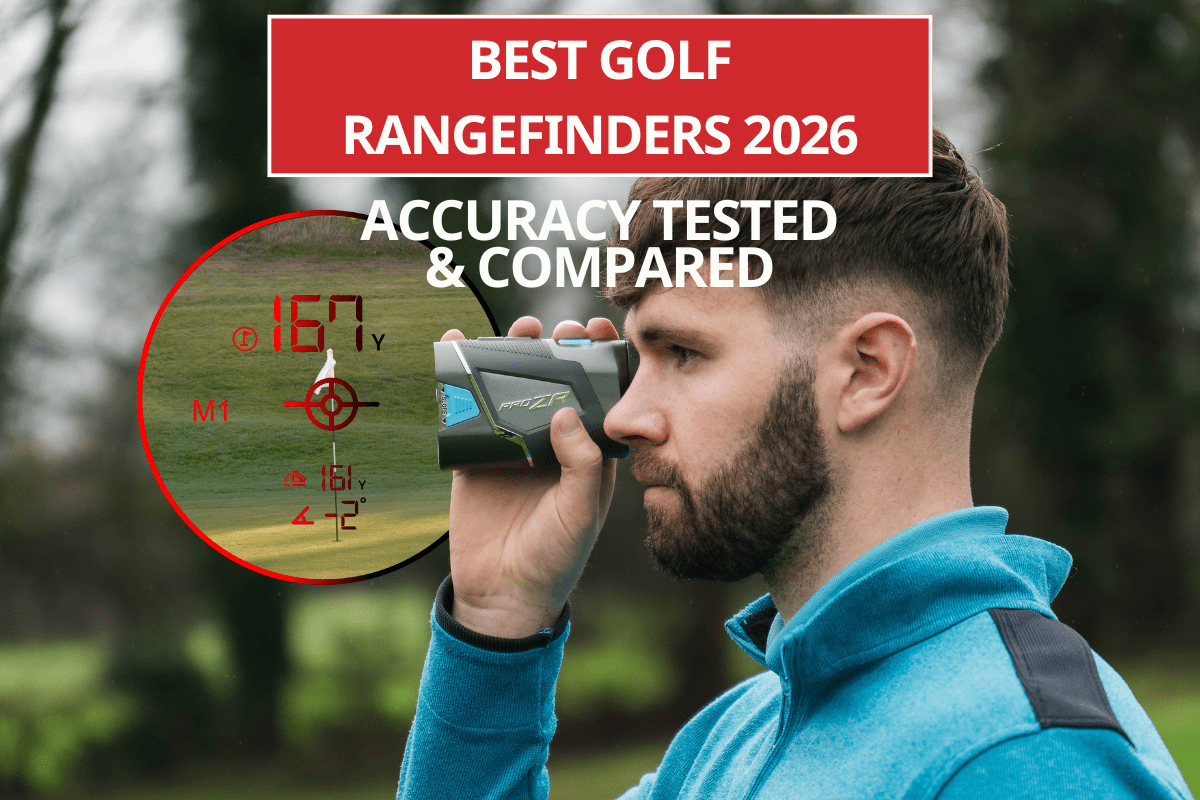
Finding the right golf rangefinder can transform your game. Standing over a 165-yard approach shot with water guarding the front of the green, knowing the exact distance—not guessing—makes all the difference between confident execution and tentative hope. For mid-handicappers looking to break through scoring barriers, a quality rangefinder isn't just another gadget in your bag—it's essential equipment for better course management, smarter club selection, and ultimately, lower scores.
We've tested the latest golf rangefinders across UK courses, measuring them against strict accuracy benchmarks and real-world playing conditions. Whether you're after laser precision, GPS convenience, or cutting-edge hybrid technology, here's what we've found actually works.
Our Top Picks: Best Golf Rangefinders for 2026
After extensive testing at Evolution Golf and on courses throughout Britain, these three rangefinders represent exceptional value and performance for intermediate golfers seeking accurate distance information.

MILESEEY GenePro G1 Touchscreen & GPS Rangefinder — £499
The GenePro G1 represents the cutting edge of rangefinder technology—a genuinely useful hybrid that delivers both laser accuracy and GPS functionality without compromise. The 2.7-inch colour touchscreen feels remarkably intuitive, similar to using your smartphone but optimised for golf. Switch between laser and GPS modes with a simple tap, or view both simultaneously for complete situational awareness. Laser performance is exceptional, with consistent ±0.5 yard accuracy up to 400 yards and reliable flag lock from 250+ yards even against challenging backgrounds. The GPS database includes over 30,000 courses worldwide with free lifetime updates, making this ideal for golfers who play various venues and want maximum information at their fingertips.

MILESEEY PF260 Tour Golf Rangefinder with Slope Switch — £169
For golfers who prioritise pure laser accuracy and tournament legality, the PF260 Tour hits a sweet spot between performance and value. The external slope switch is brilliantly simple—slide it to "Tour" mode for competition-legal distances, or "Slope" mode for practice rounds with elevation-adjusted yardages. Testing revealed consistent ±1 yard readings up to 450 yards, with reliable flag lock from 275 yards. The JOLT vibration confirms when you've locked onto the flag rather than background objects, proving highly reliable with false positives less than 5% of the time. This is the rangefinder we recommend most frequently at our Ringwood store for mid-handicappers who want straightforward accuracy without paying for features they won't use.

Shot Scope PRO L5 Laser Rangefinder — £219
The Shot Scope PRO L5 is built for golfers who want fast, reliable yardages without distraction—delivering pinpoint accuracy with premium clarity in every condition. Combining advanced laser technology with an ultra-sharp OLED display, it ensures you can lock onto your target quickly and confidently, whether you’re playing in bright sunlight or low light.
You get instant distance readings up to 1300 yards with 7x magnification, while Target-Lock Vibration provides physical confirmation when you’ve locked onto the flag—removing any doubt before you take your shot. Adaptive Slope Technology adjusts distances for elevation changes, giving you true playing yardages to improve club selection, with the option to disable for competition use.
Designed for convenience as well as performance, the built-in magnet keeps the device securely attached to your trolley or buggy, and the included carry case ensures it’s always protected and within easy reach.
If you’re looking for a fast, accurate, and easy-to-use rangefinder that enhances decision-making on every shot, the PRO L5 delivers everything you need with no unnecessary complexity.
Why Rangefinders Matter for Mid-Handicappers
If you're playing off a handicap between 8 and 14, you've already developed solid ball-striking fundamentals. The challenge now is consistency—and that's where precise distance information becomes game-changing. Most mid-handicappers lose strokes through club selection errors rather than poor swings.
Consider this: hitting a 7-iron 155 yards when you actually needed 165 yards doesn't mean you hit a bad shot. It means you had bad information. A reliable rangefinder eliminates distance guesswork, allowing you to commit fully to each shot. You'll hit more greens in regulation, reduce three-putts from poor approaches, and develop a repeatable pre-shot routine built around accurate data.
The modern golf rangefinder market has evolved significantly. Today's devices offer tournament-legal accuracy within one yard, work flawlessly in UK weather conditions, and provide slope-adjusted distances that account for elevation changes—critical on the hilly courses common throughout Britain. Where you once relied on sprinkler heads and course markers (which often measure to green centres, not pin positions), you now have pinpoint accuracy to the exact flag location.
How We Test & Compare Golf Rangefinders
Accuracy Testing Methodology
We don't rely on manufacturer specifications alone. Each rangefinder in our roundup underwent rigorous testing at Evolution Golf's Ringwood facility and on multiple UK courses. Our testing protocol includes calibration verification using surveyor-grade equipment—we measure known distances, then compare rangefinder readings against these benchmarks. Any device showing variance beyond ±1 yard fails our accuracy standard.
Repeat testing matters as much as accuracy. Each unit takes 100+ measurements to the same targets under varying conditions. Consistency is crucial—a rangefinder that gives you 152 yards once and 148 yards moments later isn't trustworthy, regardless of how accurate any individual reading might be.

We test how reliably each device locks onto flagsticks at various distances, particularly crucial for UK courses where backgrounds can be complex with trees, hedges, and buildings. Pin-seeking technology must work consistently, not just occasionally, to justify the investment.
Real-World Course Conditions
Laboratory accuracy means nothing if a rangefinder fails in actual play. We've tested every featured model in typical UK weather conditions including drizzle, full rain, bright sun, and morning dew. Temperature extremes from near-freezing winter mornings to summer heat haven't phased the units we recommend. We've measured various targets—flagsticks, trees, bunker edges, hazards—at different distances from 50 yards to maximum claimed range.
Challenging backgrounds prove particularly revealing. Dense trees, sky, white buildings—all these can confuse inferior rangefinders. Only units that performed consistently across all conditions earned our recommendation.
Types of Golf Rangefinders Explained
Laser Rangefinders
Laser rangefinders emit an invisible infrared beam that bounces off your target and returns to the device. The time elapsed calculates distance with remarkable precision—typically within 1 yard accuracy up to 400 yards and beyond.
The advantages are clear. Pinpoint accuracy to specific targets like flagsticks, trees, and bunkers. They work on any course worldwide without pre-loaded data, providing instant readings in 0.5-1 second. There are no ongoing fees or subscriptions, and they're tournament legal when slope functionality is properly disabled. The learning curve for first-time users is minimal—aim, press button, read distance.
A few things to note: they require clear line of sight to your target, and steady hands help achieve consistent readings (though vibration lock technology assists greatly). Battery life varies but typically provides 3,000-5,000 readings per charge, easily covering months of regular play.
GPS Rangefinders
GPS devices use satellite positioning and pre-loaded course maps to show distances to front, middle, and back of greens, plus hazards and layup points. Modern GPS units come as watches, handheld devices, or smartphone apps.
What makes them appealing? You get multiple distances displayed simultaneously without needing to aim at anything—just look at your screen. They show entire hole layouts with hazards marked, proving useful for course management and strategy. Advanced models track performance statistics, and they work without requiring steady hands or careful aim.
Most quality GPS units have 30,000+ courses covered, though you should verify your regular courses are included. Accuracy typically runs ±2-3 yards to green centres, perfectly adequate for most situations but less precise than laser measurements to specific pin positions. Some units require annual subscriptions for course updates. Battery life on watches usually provides 10-12 hours of play time, and signal issues occasionally occur in deep valleys.
Hybrid Systems
The newest category combines laser precision with GPS convenience. These devices use GPS for hole overview and strategy while offering laser accuracy when you need it most—measuring exact distance to the pin.
Hybrids excel because you get the best of both technologies in one device. GPS provides context showing hazards and layup zones, while laser ensures pinpoint accuracy when approaching greens. Ideal for unfamiliar courses where you want strategic information but also need precise distances. The MILESEEY GenePro G1 exemplifies this approach, seamlessly switching between modes as your needs change throughout the round.
Rangefinder vs GPS Watch: Which is Right for You?

When to Choose a Laser Rangefinder
If precision matters most to your game, laser wins decisively. Measuring 167 yards to the flag versus "middle of green is 165 yards" makes a significant difference when that green has 30 yards depth and the pin is tucked back. You're a feel player who wants exact numbers to specific targets—not approximations to green centres.
Laser rangefinders work anywhere immediately, with no course downloads or database coverage concerns. Pull it from your bag and shoot any target on any course worldwide. Most serious competitors prefer laser rangefinders (with slope switched off) because they trust the precision and don't worry about GPS accuracy variations or battery life during important rounds.
If you naturally play target-to-target, visualising specific landing spots rather than general areas, laser rangefinders suit this style perfectly. Shoot your target, get your number, execute your shot—simple and repeatable.
When GPS Makes More Sense
If you like seeing the entire hole layout with all hazards marked, GPS excels. You'll know carry distances to bunkers, layup zones, and trouble spots without shooting multiple targets. This strategic overview helps course management, particularly on unfamiliar layouts.
GPS watches display information without requiring you to aim a device, scan targets, or hold anything. Glance at your wrist, see distances, play on. This appeals to golfers who value pace of play and dislike fumbling with equipment between shots.
Advanced GPS systems like the Shot Scope Game Improvement Pack combine distance information with shot tracking and statistical analysis. You're not just measuring distance—you're building a database to guide practice and improvement priorities. Discover your true carry distances with every club, identify weak areas in your game, and make data-driven decisions about where practice time yields maximum scoring benefit.
The Hybrid Advantage
Hybrid units eliminate the choice altogether. Use GPS for hole strategy and general navigation, then switch to laser when approaching greens for pinpoint accuracy. You're paying more upfront but getting the best of both worlds—strategic information and precise measurements in a single device.
Key Features to Look For in 2026
Slope Compensation Technology
Modern rangefinders measure straight-line distance but can calculate "plays like" distance accounting for elevation change. A 150-yard shot uphill might play like 165 yards; downhill might play like 140 yards. Particularly valuable on hilly UK courses common in Scotland, Wales, and throughout England.
Tournament legality requires that devices have slope capability easily disabled for competition use. External switches like the MILESEEY PF260 Tour are most reliable—you can see at a glance whether slope is active or disabled. Menu-based toggles work but require more attention to rule compliance.
Rule 4.3a allows distance-measuring devices but not those measuring elevation or other conditions that might affect play—so slope must be switchable off during competition. Verify this before purchasing if you play any competitive golf.
Tournament-Legal Modes
If you play competitions (even casual club events), verify your rangefinder complies with Rule 4.3a. The safest option is a physical external switch clearly showing when slope is disabled. This removes any doubt during competition—competitors and officials can see your device is in legal mode without questioning you.
Magnification and Display Quality
Most quality rangefinders offer 6x or 7x magnification. Higher magnification (8x+) makes targets appear larger but requires steadier hands to use effectively. For UK courses where most approach shots fall under 200 yards, 6x magnification provides optimal balance between target clarity and ease of use.
Contrasting displays (red on black, black on white) work better than full colour in varied light conditions. Test visibility in bright sunlight if possible—UK summers can make poor displays nearly unusable. Many golfers overlook diopter adjustment, but this ensures crisp focus for your specific eyesight and proves critical for confident target acquisition, especially if you wear glasses.

How to Get Maximum Value from Your Rangefinder
Steady Hand Technique
Rangefinder accuracy depends on stable aim. Rest your hand against your body or cheek for added steadiness. Many golfers develop a consistent routine: elbow tucked into side, rangefinder pressed to cheekbone, slow squeeze of the button. This creates a stable platform reducing shake and ensuring reliable readings.
Practice at home measuring distances to various objects around your house and garden. Builds confidence and technique before taking it to the course. You'll learn your device's quirks, understand when it's locked properly onto targets, and develop muscle memory for your aiming routine.
Target Lock Features
Most quality rangefinders include "flag lock" or "pin-seeking" technology that vibrates when you've locked onto the flag rather than background objects. Don't ignore this feedback—it's the difference between measuring to the pin at 165 yards versus the trees behind at 185 yards.
After getting a reading, shoot again for verification. If you get the same number twice, confidence increases dramatically. Different readings suggest you're not locking consistently—slow down and ensure proper flag lock before trusting the distance.
Battery Life Management
Laser rangefinders use lithium CR2 batteries lasting thousands of readings. Keep a spare in your bag—they're inexpensive insurance against being caught without power. Cold weather drains batteries faster, so if playing winter golf, warm the rangefinder in your pocket between shots to maintain performance.
GPS devices require charging after every 2-3 rounds. Don't wait until the battery is dead—GPS units perform worse when low on power, showing slower acquisition and less accurate positioning. Consider a portable power bank for 36-hole days or tournaments where you need guaranteed full-day performance.
Common Rangefinder Mistakes to Avoid
Shooting the wrong target ranks as the most common error, especially on wooded courses where it's easy to accidentally measure to trees behind the flag. Always verify flag lock confirmation through vibration or display indicator. If the distance seems wrong, shoot again—better to spend an extra three seconds than hit the wrong club.
Ignoring slope on hilly lies costs strokes unnecessarily. When slope mode is available, use it for practice rounds. You'll be surprised how much elevation affects club selection—often 1-2 clubs difference on severe slopes. This knowledge improves your feel for elevation even when you must disable slope for competitions.
Not accounting for wind remains a critical oversight. Rangefinders measure distance, not how far your ball will travel through the air. On windy days (common in UK links golf), adjust club selection beyond what the rangefinder suggests. A 150-yard shot into a 20mph headwind might need a 165-yard club.
Measuring to green centre only proves insufficient for precise approaches. GPS devices showing green centre distance aren't enough on deep greens measuring 30+ yards. Pin position changes club selection significantly—this is where laser rangefinders excel, measuring exact flag location rather than approximate green centre.
Forgetting to check tournament rules before play can lead to disqualification. Some competitions allow GPS but not laser, others allow distance-only devices (no slope), some permit nothing. Check before you play—using illegal technology, even accidentally, has serious consequences in competition.
Frequently Asked Questions
Are golf rangefinders worth it for mid-handicappers?
Absolutely. Mid-handicappers (8-14 handicap) are at the perfect stage to benefit from accurate distance information. You've developed consistent ball-striking but often lose strokes through poor club selection or course management. A quality rangefinder eliminates distance guesswork, helping you hit more greens in regulation and make smarter strategic decisions. Most players see immediate improvement in approach shot accuracy and commit more confidently to each shot when they trust their distances. The investment typically pays for itself within a season through better scoring and increased enjoyment.
What's the difference between slope and non-slope rangefinders?
Slope rangefinders measure straight-line distance but also calculate elevation change and provide adjusted "plays like" yardage. For example, a 150-yard shot with 15 feet of elevation gain might display "plays like 158 yards" with slope enabled. Non-slope devices (or slope-disabled) show only the actual distance. Tournament rules require slope to be switchable off during competition, so most quality rangefinders include a physical switch or menu toggle to disable this feature for rule compliance. The MILESEEY PF260 Tour features an external switch making compliance verification simple and obvious.
How accurate are golf laser rangefinders?
Quality laser rangefinders provide accuracy within ±1 yard up to 300-400 yards—more than sufficient for golf where even tour professionals allow ±2-3 yard margins. GPS devices typically offer ±2-3 yard accuracy to green centres. The practical difference: laser rangefinders measure exact flag position, while GPS shows green centre, front, and back but not precise pin location. For approach shots where pin position matters, laser precision helps optimise club selection and commit confidently to your shot.
Can you use a rangefinder in competitions?
Yes, under Rule 4.3a, distance-measuring devices are permitted in most golf competitions unless the Local Rule prohibits them (check competition rules beforehand). However, devices that measure or gauge slope, wind, or other conditions affecting play are NOT permitted. This is why rangefinders must have slope functionality easily disabled through a physical switch or clear menu setting. Always verify your device is in tournament-legal mode before competition rounds. Some club events still prohibit all electronic devices, so checking beforehand remains essential.
What's better for UK courses: laser or GPS?
Both excel on UK courses but for different reasons. Laser rangefinders handle UK weather (rain, fog) better than GPS and provide pinpoint accuracy essential on undulating greens common at British courses. The ability to measure exact yardages to specific features—bunkers, burns, hazards—proves invaluable for strategic play.
GPS devices show strategic layout including burn crossings, pot bunkers, and blind hazards—particularly useful on links courses where trouble isn't always visible from the tee or fairway. For hilly UK parkland courses, slope-enabled rangefinders (either laser or GPS) prove particularly valuable, accounting for the elevation changes that significantly affect club selection.
Hybrid units like the MILESEEY GenePro G1 combine both technologies, ideal for the varied course types found throughout Britain. You get GPS strategic information for course management plus laser precision for approach shots—the complete package in a single device.
Final Thoughts: Which Rangefinder Should You Buy?
After testing dozens of models and comparing performance across various UK courses and weather conditions, we're confident in these recommendations based on your specific needs and priorities.
For Maximum Technology & Information: The MILESEEY GenePro G1 Touchscreen & GPS Rangefinder (£189.99) delivers everything a modern golfer needs. Hybrid laser and GPS functionality, intuitive touchscreen interface, excellent accuracy, and comprehensive course data make this our top pick for golfers who want complete distance information and aren't intimidated by technology. The ability to seamlessly switch between laser precision and GPS overview provides flexibility unmatched by single-function devices.
For Pure Laser Accuracy & Value: The MILESEEY PF260 Tour Golf Rangefinder (£139.99) offers tournament-legal precision without unnecessary complexity. Reliable flag lock, external slope switch, and proven UK weather performance make this ideal for mid-handicappers who value straightforward accuracy. This is the device we use most often for customer demonstrations at our Ringwood store because it represents the sweet spot between performance and value.
For Data-Driven Improvement: The Shot Scope Game Improvement Pack (£249.99) goes beyond simple distance measurement to reveal exactly where you're losing strokes. If you're serious about improvement and enjoy analytical feedback, the combination of GPS distances and comprehensive shot tracking provides insights no traditional rangefinder can match. You'll discover your true club distances, identify scoring weaknesses, and make informed decisions about where practice time yields maximum benefit.
The best golf rangefinder isn't the one with the most features—it's the one you'll actually use every round. Whether you choose laser precision, GPS convenience, or hybrid technology, committing to accurate distance information will transform your course management and lower your scores.
Still uncertain which option suits your game best? Visit Evolution Golf's Ringwood store where our expert team can demonstrate each device and discuss your specific needs. We'll help you understand which technology aligns with your playing style, typical courses, and improvement goals. Book a consultation through our website at evolutiongolf.co.uk or contact us for personalised advice on finding the perfect distance-measuring solution for your game.